Data Entry Control (DEC)
DEC is available to restrict catalogue values to e.g. Cost Centres for a Legal Entity.
Note
When in force, these restrictions apply to the entry of documents (e.g. Purchase Invoice) as well as any reporting & enquiries.
A User may be in multiple DAC Groups and when this is the case, will inherit the aggregate access.
Note
To view the legacy version, please select Legacy User Guide.
How to view Data Entry Control
Viewing Data Entry Control
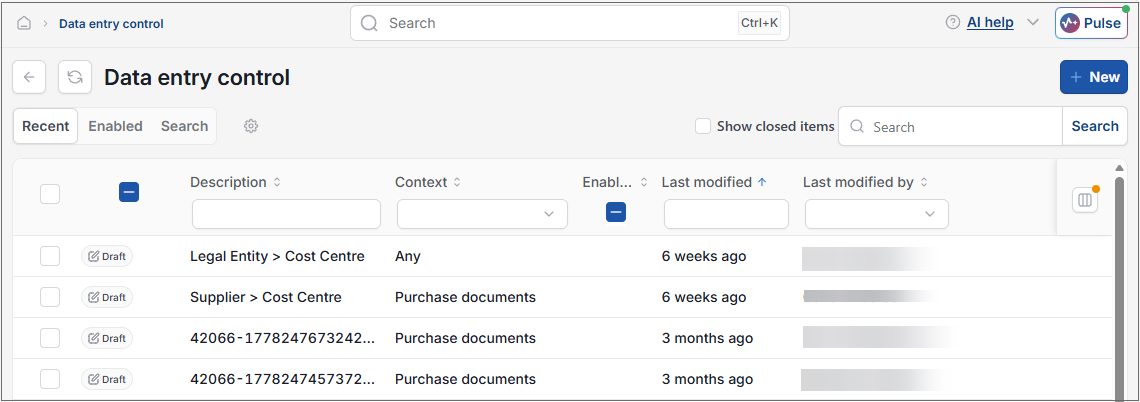
As per Generic Navigation options, either from left-hand navigation panel, expand Settings and select Data entry control from the User Access folder or enter Data entry control in the Search option.
This will then show the Data entry control on the system where normal customisation of Sets can be used.
Tip
To modify the columns displayed, select  option on the right of the column display, then tick/untick the information you want to hide or display.
How to create Data Entry Control
Creating Data Entry Control
Select Data entry control from one of the options as shown above in Viewing Data Entry Control.
Select New to create a new DEC.
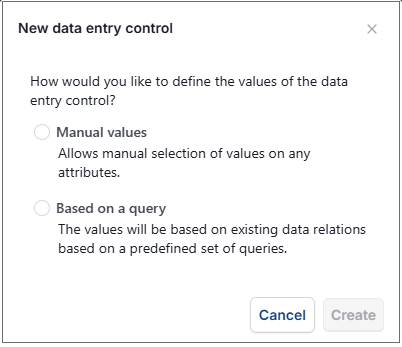
Select how you want to define the values of the Data entry control and then select Create.
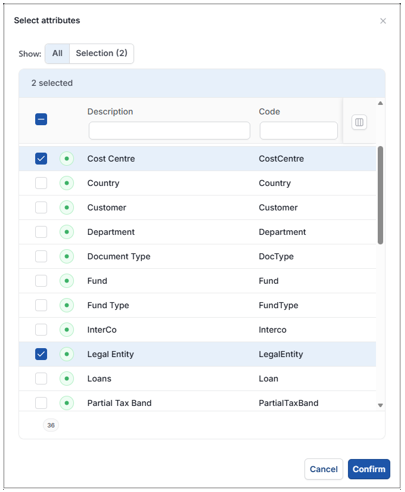
Select the Attributes you wish to use followed by Confirm.
Tip
You must have a minimum of 2 attributes, but you may have 3 or more if you wish.
Select the Context from dropdown list or via the
 icon.
icon.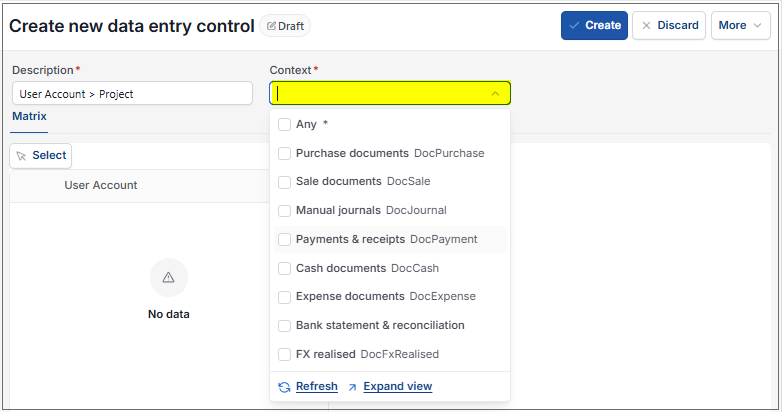
Note
You can apply the DEC to selected document contexts e.g. Purchase documents or even all document contexts.
If, as in the example given here, you only choose Purchase Documents then the DEC will apply to all Purchase documents.
You can change the context later.
Select the primary attribute values that you want to apply the DEC.
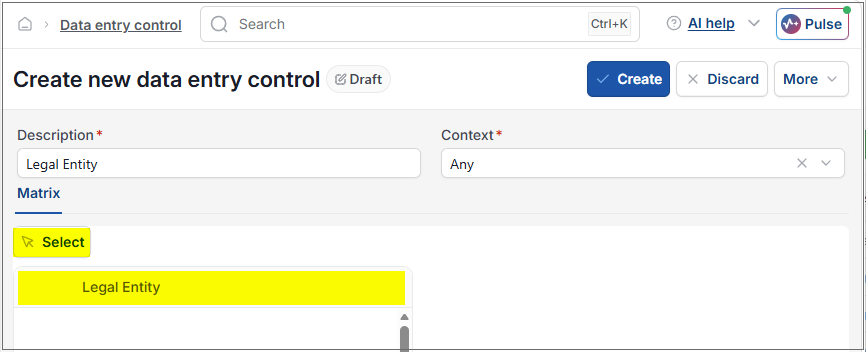
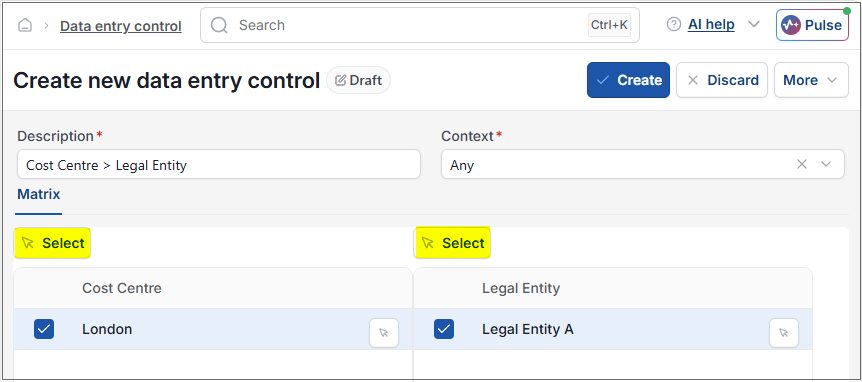
Select each Attribute in turn and press Select in enter required values.
WAITING BUG FIX
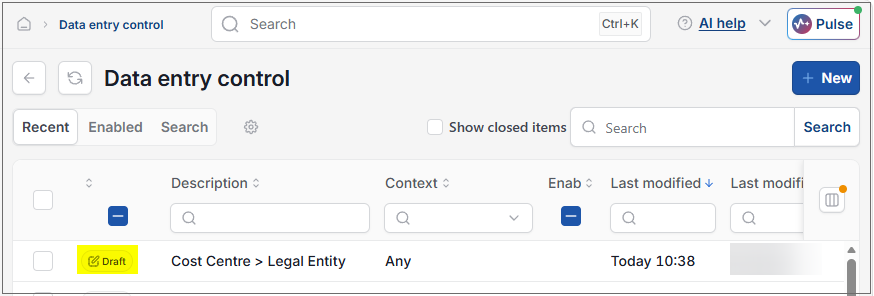
When you have finished, press Create to create the DEC in draft.
The new Data Entry Control will be created but not yet Enabled.
How to restrict users with Data Entry Control
Restricting users with Data Entry Control
Select Data entry control from one of the options as shown above in Viewing Data Entry Control.
Select New to create a new DEC.
Select how you want to define the values of the Data entry control and then select Create.
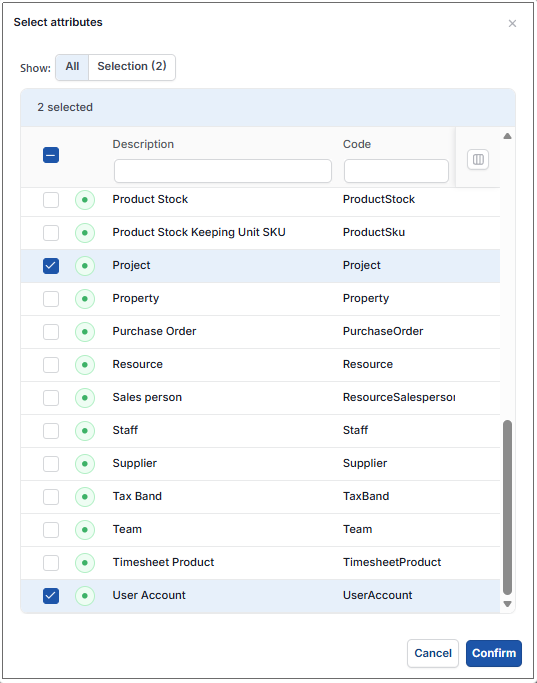
Select User Account plus other attributes you wish to use followed by Confirm.
Tip
You must have a minimum of 2 attributes, but you may have more 3 or more if you wish.
Select the Context from dropdown list or via the
icon.Select the User Account in the Matrix, then select the Users for this DEC, followed by Confirm.
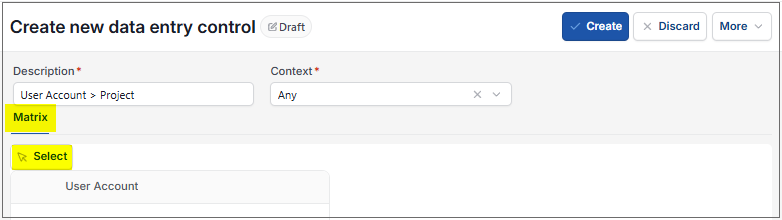
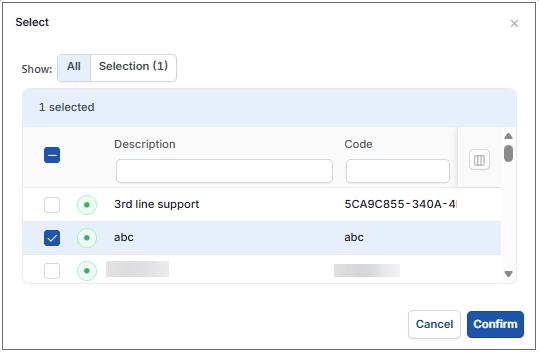
Select each User in turn and then press Select for the secondary attribute and choose the values you wish to use for the User followed by Confirm.
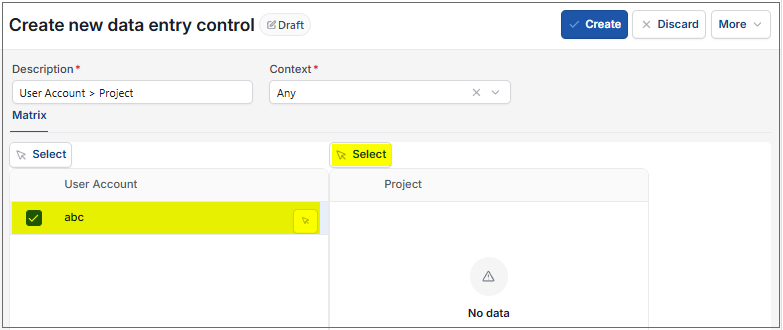
When you have finished, press Create to create the DEC in draft.
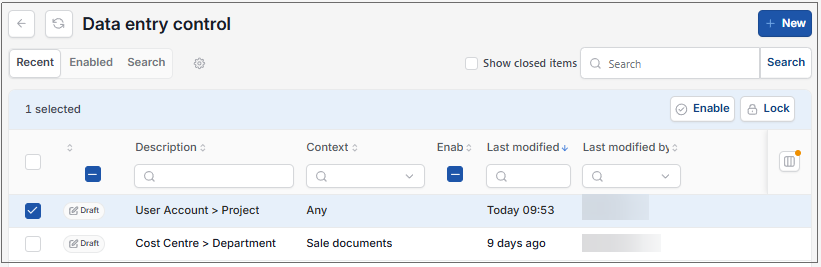
The new Data Entry Control will be created but not yet Enabled.
How to enable Data Entry Control
Creating Data Entry Control
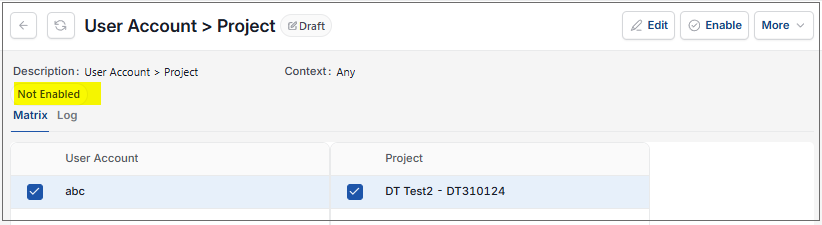
Once the Data Entry Control has been created, it then needs to be Enabled.
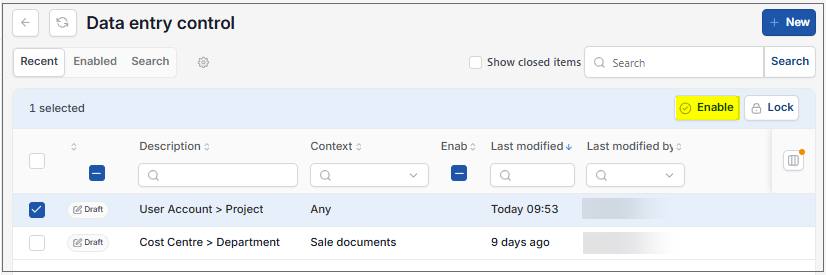
Select Data Entry Control to Enable.
Select Enable option.
Note
The DEC will not work until you have Enabled it. You may wish to defer enabling until you have completed the DEC setup.
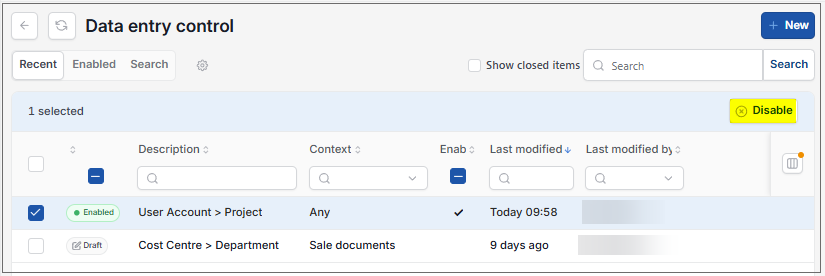
Once Enabled, the Date Entry Control will show with a green Enabled watermark.
How to disable Data Entry Control
Disable Data Entry Control
Select Disable to stop the DEC working.
How to Import/Export Data Entry Control
Import/Export Data Entry Control
Adds the ability to create Data entry control combinations.
Select Data Entry Control from one of the options as shown above in Viewing Data Entry Control.
Open the Data Entry Control to import.
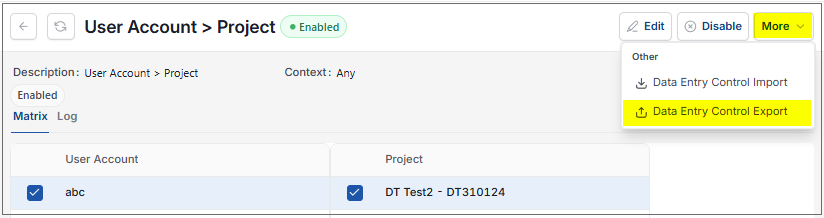
Select the
 button and select Data Entry Control Import.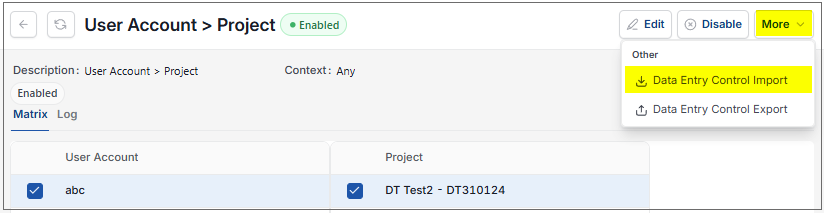
Note
Import is not available on query based DECs as the matrix for these is driven by the query, not user input.
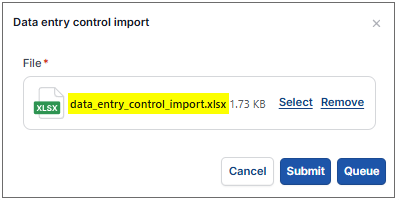
Enter the name of the Excel file to import, which is saved on an external source.
Tip
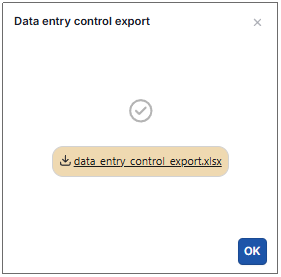
To create an Import file with the correct field names and formatting, Export a file first and save to your external source. Then use this file to add details ready to import.
Fields to be included will depend on the data entry combination being exported/imported.
It is suggested that the fields are shown in the file in the same order as they are required in the Data entry control. So, if the data entry control is Account > Department, column 'A' would be Account and column 'B' would be Department.
The number of columns will depend on the number of attributes in the data entry control.
Each field can be a multi-select field and so it is suggested that a semi-colon is used to differentiate different values within a field.
The import will follow the same rules as are applied when adding the data entry combinations manually. Each combination of values for attributes must be unique and cannot be repeated.
Select Submit.
Selecting Queue from the dropdown option will queue the import process until other actions in iplicit are completed.
Warning
iplicit allows a maximum of 5,000 rows in a single Import.
If your Import is too large, an error message will tell you that the Import cannot be processed and will advise you to create smaller Import files.
If the latter is not possible, please contact Customer support.
Updated August 2026